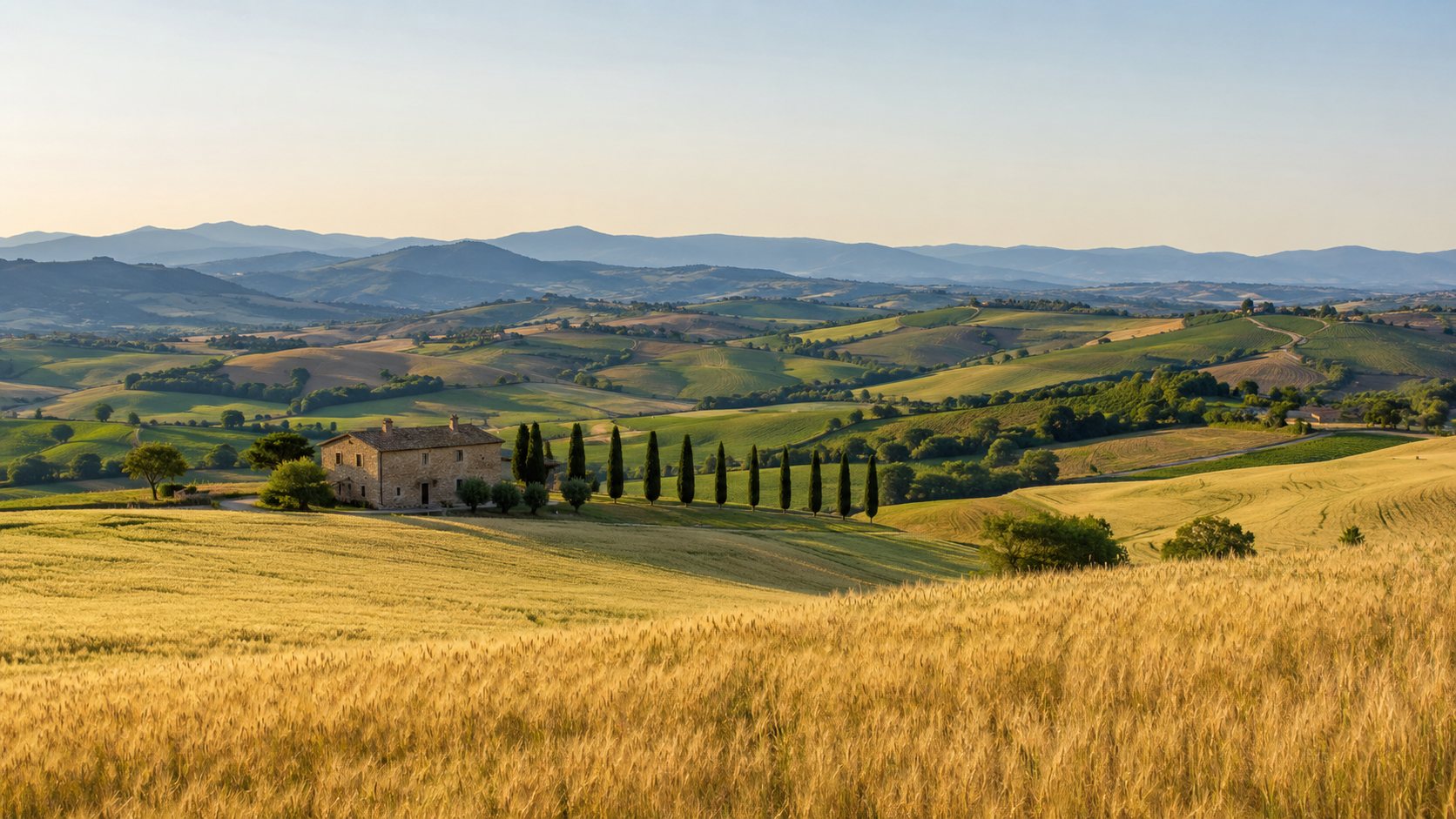
Le Marche has quietly become the answer for people who love the idea of Tuscany but balk at the prices and the crowds. The same rolling hills, the same honey-coloured stone farmhouses, the same long lunches: simply with fewer foreign buyers competing for them. If you are seriously weighing it up, our overview of buying property in Le Marche sets the scene. This guide goes deeper into what actually matters when you look at a country property here, and where the quiet hides genuine complications.
WHAT TO CHECK FIRST
- Catasto: do the registered plans match the building as it stands today?
- Planning: are all works permitted, or is there unresolved abuso edilizio?
- Seismic: what zone is the property in, and is there structural and agibilita documentation?
- Land: are the fields, olive grove and outbuildings actually part of the sale?
- Access: is the track to the house covered by a registered servitu di passaggio?
- Utilities: where do water, drainage and power come from, and who maintains them?
How Le Marche compares to Tuscany and Umbria
Geographically and culturally, Le Marche sits beside Umbria and shares much of what draws people to inland Tuscany. You will find the same patchwork of vineyards and sunflower fields, the same hilltop towns, and the same stone casolari built for farming families generations ago. The headline difference is price: away from the best-known spots, rural property in Le Marche tends to cost noticeably less than the equivalent in Chianti or the Val d'Orcia, though we will not put a figure on it because every comuna and every ruin is different.
The second difference is exposure. Le Marche has drawn far fewer foreign buyers, which means less competition but also a thinner layer of English-speaking professional infrastructure around a sale. The third is geography in your favour: the region runs from the Apennine mountains in the west to a long Adriatic coastline in the east, so you can have hills and beaches within an hour of each other. If you are comparing regions head to head, our guide to buying a Tuscan farmhouse is a useful counterpoint, because the legal and structural questions are nearly identical even where the price tags are not.
The restoration reality of a country casolare
Most of the romantic listings are old farmhouses that have been empty for years, partly restored, or restored to a standard that does not suit a modern household. A casolare sold as habitable may still need rewiring, replumbing, a new roof structure, damp treatment and insulation before it is comfortable through a Marche winter, which is colder inland than the brochures suggest. Stone walls are heavy and unforgiving, and changing layouts often means structural work rather than simple partitioning.
Before you fall for the view, get a realistic sense of the spend. Building costs in rural Italy have risen, skilled trades can be booked months ahead, and a half-finished restoration can hide as many problems as it solves. Treat the asking price as the start of the budget, not the end of it, and have someone independent look at the fabric of the building rather than relying on the seller's optimism.
Catasto accuracy and unresolved planning
The catasto is the land and buildings registry, and in the countryside it is often out of step with reality. Over decades, owners add a veranda, enclose a porch, convert a barn or move an internal wall without ever updating the records or obtaining permission. The result is abuso edilizio: works that do not match what is registered or permitted. This is one of the most common and most expensive surprises in rural Italian purchases, because unresolved discrepancies can stall a sale, complicate any future works, and in some cases require costly regularisation or even reversal.
The fix is documentary diligence: comparing the registered plans against the building as it physically stands, and confirming that every structure has the planning history to back it up. This is precisely the kind of thing an independent buyer-side check exists to catch, before you are committed rather than after.
Is the land and access genuinely included?
A farmhouse is rarely just a house. The listing photos may show olive terraces, a vegetable garden, a ruined barn and a sweep of field, but not all of it is necessarily in the sale. Rural plots are frequently split between heirs, and a neighbouring relative may own the very field that gives the property its privacy. Establish exactly which parcels are included, by their catasto references, and what stays with someone else.
Access deserves the same scrutiny. Many country houses are reached by a long private track that crosses land you will not own. A right of way needs to exist as a registered servitu di passaggio, not merely as an informal arrangement that has worked for years because everyone got along. Where access, a shared well or a boundary is unclear, a trusted network of independent Italian professionals can confirm the position from the records rather than from a handshake.
Rural utilities: wells, septic and private tracks
Country properties in Le Marche are often off the mains for one service or another. Water may come from a private well or a shared spring, drainage from a septic system rather than public sewerage, and the access track may be maintained, or not, by an informal group of neighbours. None of this is a reason to walk away, but all of it needs to be understood before you sign.
- Confirm the water source, its reliability through summer, and whether any sharing arrangement is documented.
- Check that drainage is compliant and that the septic system is sized and sited correctly.
- Establish who is responsible for maintaining private tracks and shared infrastructure, and how costs are split.
- Verify that electricity and any connection are adequate for a restored, year-round home.
Seismic risk and checking the structure
This is the one that genuinely sets parts of Le Marche apart. The region sits in a seismically active part of central Italy, and the 2016 earthquakes caused serious damage in inland areas near the Apennines. Risk varies considerably by location, so the first question is which seismic zone a property falls in, and the second is how the building has actually performed and been repaired.
For an older stone casolare, you want evidence that the structure is sound, that any past damage was repaired properly and with permission, and that the relevant certification, including agibilita (the certificate confirming a building is fit for habitation), is in order. Some buyers actively look for properties already strengthened to modern anti-seismic standards. Whichever way you lean, this is not a corner to cut, and it is worth having the structure and its paperwork assessed independently.
Coast, inland hill towns, and getting there
Decide early what kind of Le Marche you want. The Adriatic coast offers beaches, resort towns and easier amenities but more seasonal bustle. The inland hill towns, places like those around the Sibillini mountains, offer quiet, space and lower prices, at the cost of distance from services and harder winters. Many buyers split the difference and look for a hillside property within reach of both.
Access is better than the region's quiet reputation implies. Ancona has an international airport, and both Bologna and Rome are reachable by car or train for wider connections. That makes Le Marche viable for people splitting time between Italy and the US or UK, without the premium that comes with the most fashionable addresses.
Frequently asked questions
Is Le Marche really cheaper than Tuscany?
Generally yes, particularly inland and away from the best-known towns, though the gap depends entirely on location and condition. A cheaper headline price can also reflect more restoration work, so compare the total cost of getting a property habitable, not just the asking figure.
How serious is the earthquake risk?
It varies a great deal across the region. Some areas are in higher seismic zones than others, and the 2016 events were concentrated inland near the mountains. The practical answer is to check the specific zone for any property you consider, and to confirm the structure and its certification rather than generalising about the region.
Do I need help if I do not speak Italian?
It is strongly advisable. Le Marche has fewer English-speaking professionals around a sale than Tuscany, and the documents that matter most, the catasto, planning history and agibilita, are all in Italian. Independent help on your side, separate from the seller and agent, reduces the chance of an expensive misunderstanding.
Sources & further reading