
CASE STUDY
Case study: the Puglia trullo that wasn't fully legal
How an independent review caught a gap between a trullo's listed floor area and its registered plans, before the buyer signed.
By the Scalini Group team | 25 Jun 2026 | 7 min read
CASE STUDY
How an independent review caught a gap between a trullo's listed floor area and its registered plans, before the buyer signed.
By the Scalini Group team | 25 Jun 2026 | 7 min read
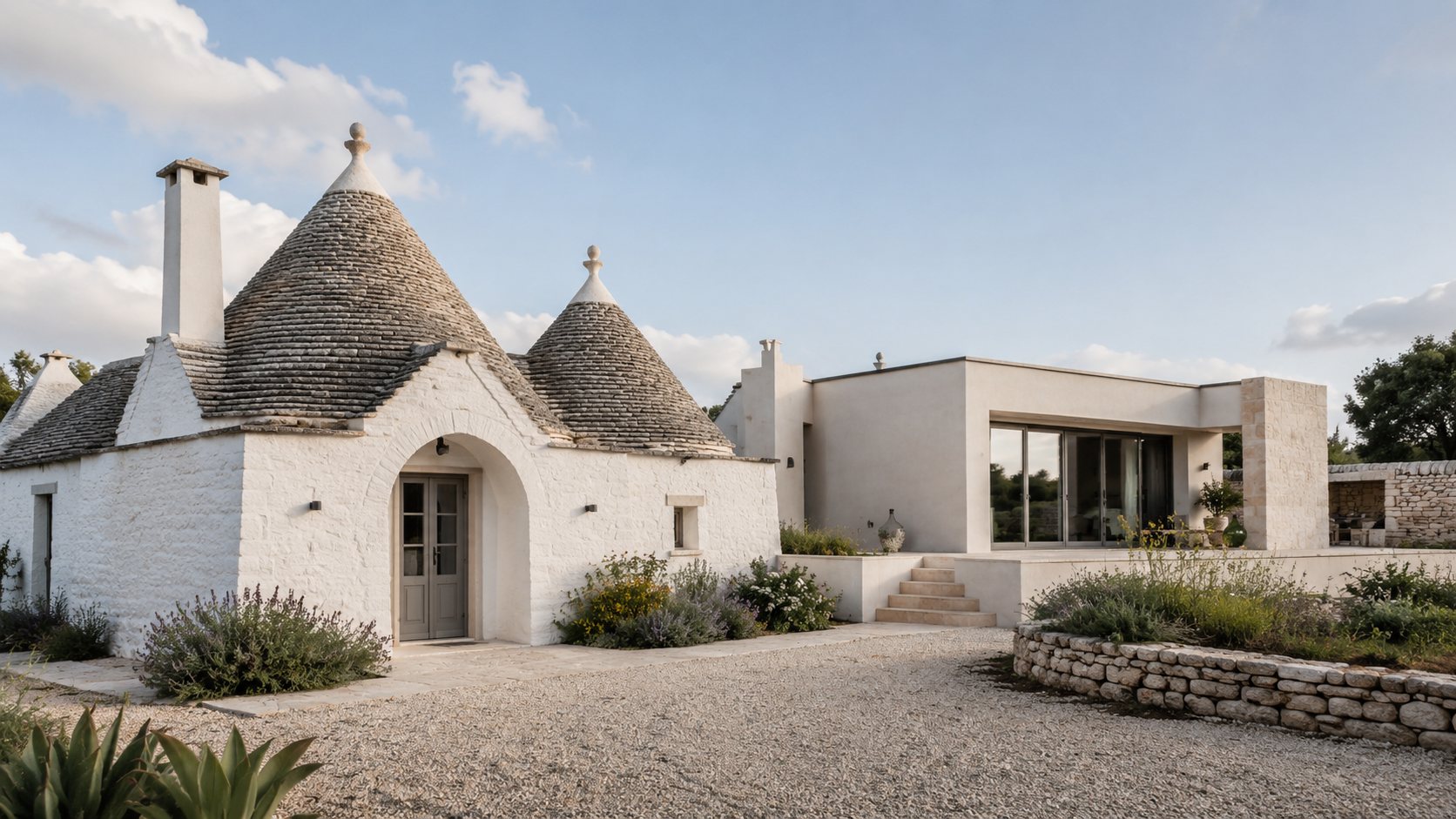
An illustrative, anonymised composite based on situations we commonly see. Details are for explanation, not a description of a specific client or property.
A couple from the United States had been looking for two years. They wanted a restored trullo near the Itria Valley, the kind of stone cone-roofed building that drew them to Puglia in the first place, with enough space to host family through the summer. They found it: a beautifully photographed property a short drive from one of the white hill towns, a classic trullo joined to a more modern extension that gave it a proper kitchen, a second bathroom and a bright sitting room opening onto a terrace. The listing described it as fully restored and habitable, quoted a generous floor area, and was priced accordingly. They were ready to make an offer. Before they did, they asked us for an independent second opinion.
THE CASE AT A GLANCE
On paper it was exactly what they wanted. The original trullo had been carefully restored, the dry-stone cone re-laid, and a single-storey extension added alongside it to create year-round living space. Photographs showed a veranda area that had been partly closed in to make a small additional room, comfortable and shaded, clearly used as part of the home. The agent was friendly and responsive, and there was nothing obviously wrong. That is usually the point. The problems that matter most in buying property in Puglia are rarely visible in the photographs. They sit in the paperwork, or in the gap between the paperwork and the building that is actually standing there.
Our review starts with a simple discipline: read what is being sold, then read what is officially recorded, and see whether the two describe the same building. The listing quoted a habitable area in the region of 110 square metres. When we looked at the catasto (the land registry) record and the plan attached to it, the registered footprint was meaningfully smaller, closer to the original trullo plus a more modest extension. The closed-in veranda room, and a portion of the added floor area, did not appear on the registered plan at all.
A mismatch like that is not proof of anything on its own. Registry plans can lag behind legitimate work, and a catasto update is a different thing from a planning permission. But the direction of the gap matters. When the building on the ground is larger than the building on the plans, and the extra space is exactly the kind of room that changes how a property is used and valued, it is a strong signal that some of the work may have been done without the proper planning permission. In Italian terms, that is a possible abuso edilizio: building work carried out without, or beyond, the necessary authorisation from the comune.
We do not certify the legal status of a building. That is the job of licensed professionals. What we did was identify the gap clearly, explain what it might mean, and translate it into a precise list of things the buyer needed verified before committing. The checks we set out included:
We also flagged the practical point that the Itria Valley and its surroundings carry landscape and heritage sensitivities. Work on a trullo can attract additional constraints, which makes "we will just sort the paperwork later" a riskier assumption than a buyer might expect.
The reason this matters is that, in Italy, planning irregularities tend to follow the building, not the person who created them. If the couple had completed the purchase as it stood, they could have inherited the abuso: the unpermitted room would have become their problem to regularise, at their cost, with no guarantee that regularisation was even possible. An unresolved abuso edilizio can also complicate a future sale, a mortgage, or an insurance claim, and a careful notaio may be unwilling to complete a transfer cleanly while it is outstanding.
Armed with the gap, the buyer had real choices, all of them better than finding out afterwards. They could ask the seller to complete a sanatoria and bring the building fully into line before completion, with proof provided. They could renegotiate the price to reflect the cost and uncertainty of regularising it themselves. Or they could walk away. None of these required a confrontation. It simply meant the conversation happened before signing, when the buyer still held the leverage, rather than after, when they held the liability. The formal work of confirming the position and putting it right belonged to licensed local professionals: a geometra to survey and compare the plans, the comune to confirm the permitting history, and a notaio to ensure nothing unresolved passed to the buyer at the deed.
Restored trulli are among the most charming properties in Italy, and most sales are perfectly sound. But the very thing that makes them special, generations of additions, restorations and adaptations to old stone structures, is also what makes their paperwork worth reading closely. A few patterns are worth carrying with you:
This buyer did not need an expert to tell them the trullo was beautiful; they could see that for themselves. What they needed was someone to read the records calmly, notice that the building was bigger than its own plans, and say so plainly before any money moved. That is the whole value of a buyer-side check before you sign: not to kill the dream, but to make sure the home you fall in love with is the same home that exists on paper, fully and legally yours from the day you take the keys.
Contact us and we'll tell you which level of check is most suitable. Independent, buyer-side, no commission from the sale.
Contact us ScaliniPRIVATE RELOCATION OFFICE