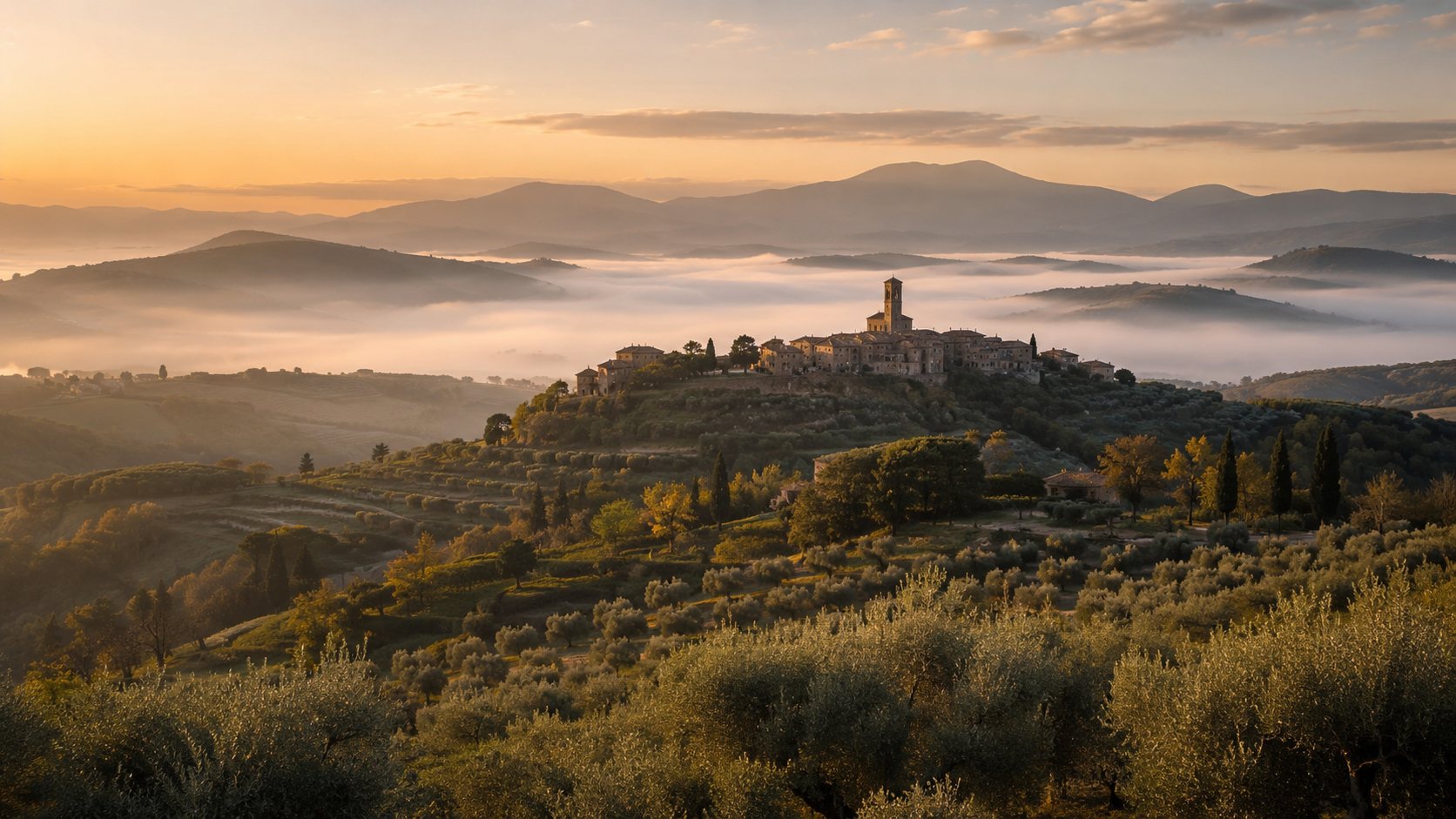
Umbria is often called the green heart of Italy, and for foreign buyers it tends to arrive as a quieter, gentler alternative to Tuscany next door: the same rolling hills and stone farmhouses, fewer crowds, and prices that usually sit lower. If you are weighing up buying property in Umbria, the landscape is the easy part. What sits underneath a beautiful casale (the paperwork, the structure, the water supply, the right of access) is where buyers from the US and UK most often get caught out.
WHAT TO CHECK FIRST
- Catasto: does the registered plan match what is physically standing today?
- Planning: are past works permitted, or is there an abuso edilizio waiting to surface?
- Access: is the road legally yours, or a servitù di passaggio over a neighbour's land?
- Water: mains, well or spring, and is the supply documented and legal?
- Structure: any seismic damage or repairs, and does agibilità exist?
- Constraints: landscape or heritage restrictions on what you can change.
How Umbria differs from Tuscany
The two regions share a border and much of the same scenery, but the buying experience is not identical. Umbria generally sees fewer foreign buyers, which means less competition, fewer properties dressed up specifically for the international market, and asking prices that tend to be more modest for comparable stone houses. That can be an advantage. It also means fewer agents who routinely work with overseas clients, and listings that assume local knowledge you may not have. The lower entry price is real, but it is not a discount on the due diligence required: an inexpensive casale with planning problems can cost far more to resolve than a dearer house that is clean on paper.
Rural farmhouses and the restoration reality
Much of what draws people to Umbria is rural: a casale or podere set in olive groves or oak woodland, often part-restored or "to finish". The romance of restoration is genuine, and so is the cost. Works in the countryside frequently run longer and dearer than first quoted, partly because access for machinery is awkward and partly because what looks like a cosmetic job uncovers structural or services work underneath. Before you fall for the views, it is worth reading honestly about what a renovation involves: our piece on the realities of renovating in Italy sets out where budgets tend to slip. Treat any "ready in a few months" promise with caution and price the work properly before you commit.
Catasto mismatches and planning history
Italian rural property very often carries a gap between the catasto (the land registry plan) and the building that actually stands on the ground. An extra room, a closed-in loggia, a converted barn or a moved staircase may never have been registered or permitted. Where that work was done without authorisation it is an abuso edilizio, and an unresolved one can block a sale, prevent a mortgage, or land on the next owner to regularise. This is not a reason to walk away from older houses (almost all of them have some history), but it is a reason to verify the planning record carefully rather than trust the listing. An independent buyer-side check reads the catasto, the planning file and the building as one picture and tells you what does not line up.
Access, wells, water and utilities
In the Umbrian countryside, the things a city buyer takes for granted cannot be assumed. The lane to the house may cross someone else's land, which means your legal right of access depends on a servitù di passaggio being properly recorded, not merely the way things have always been done. Water may come from a private well or a spring rather than the mains, and that supply needs to be documented, tested and legally permitted. Mains drainage is often absent, so septic systems and their compliance matter. Electricity, broadband and even reliable mobile signal vary sharply from one valley to the next. None of this is a dealbreaker, but each item is a question to answer in writing before you buy, not a surprise to discover afterwards.
Seismic risk and structure
Parts of Umbria sit in a seismically active belt. The 1997 Umbria and Marche earthquake and the 2016 central Italy sequence both affected areas of the region, and many buildings have a history of damage, repair or strengthening work. This is not a reason to avoid Umbria; it is a reason to understand the structure you are buying. Ask whether the house was affected, whether repairs were carried out with proper authorisation, and whether agibilità (the certificate of fitness for use) exists and is valid. A qualified surveyor or structural engineer should assess the building itself; what matters at the diligence stage is making sure that assessment happens and that the paperwork behind any past repairs holds up.
Landscape and heritage constraints
Umbria's beauty is protected, and protection comes with rules. Many rural and hill-town properties fall within landscape, environmental or heritage constraints that limit what you may change: roof materials, window openings, external colours, new structures, even swimming pools can be restricted or require specific consent. These constraints are normal and manageable, but they shape what your restoration can realistically be. If your plans depend on extending, adding a pool or altering the exterior, confirm what is permitted on that specific parcel before you exchange, not after.
Towns versus deep country, and getting there
A practical early decision is whether you want to be in or near a town (Perugia, Spoleto, Todi, Orvieto, Assisi) with services, neighbours and walkable life, or deep in the country with isolation as the trade for privacy and space. Deep-country houses are cheaper per square metre and more demanding on access, water and utilities; town and edge-of-town property is dearer but simpler to live in year-round. On travel, Perugia has a small airport with seasonal connections, while Rome and Florence are both within driving or rail reach, which keeps Umbria accessible without putting you in the busiest tourist corridors.
Frequently asked questions
Is Umbria really cheaper than Tuscany?
As a general pattern, comparable stone houses tend to cost less in Umbria than in the best-known parts of Tuscany, with less foreign-buyer competition. We do not quote figures because prices vary widely by location, condition and how much restoration is already done. The saving is real, but it should never substitute for proper checks on the specific property.
Do I need to worry about earthquakes?
You should be informed rather than alarmed. Some parts of Umbria are seismically active, and houses there may have a history of damage or strengthening. The sensible approach is to confirm the building's condition through a qualified surveyor or structural engineer, and to verify that any past repairs were authorised and that agibilità is in order.
Can I trust the property listing's description?
Treat a listing as a starting point, not a statement of fact. Floor areas, the number of rooms, access and even whether a building is fully legal can differ from the registered position. The role of buyer-side diligence is to read what is really being sold and tell you what to verify, and through whom, before you are committed.
Sources & further reading
Verifying a purchase is a job for independent professionals. Where the work needs a notary, a surveyor, a structural engineer or a lawyer, we point you to a trusted network of independent Italian professionals rather than acting in those roles ourselves.