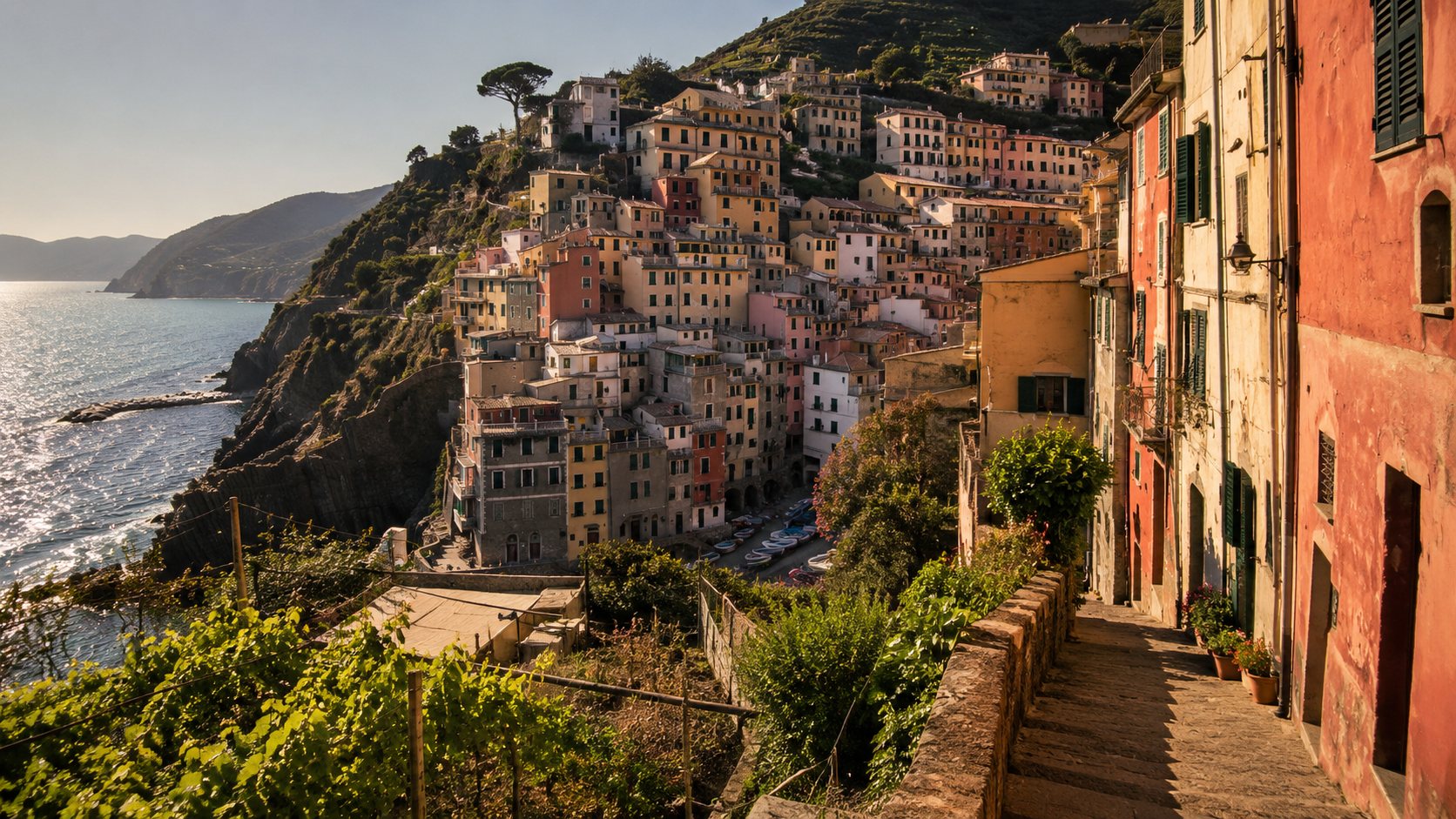
Liguria is one of Italy's most photographed coastlines, and for good reason: the pastel villages of the Cinque Terre, the discreet wealth of Portofino, the long sweep of the Riviera. It is also one of the trickiest places in the country to buy well, because so much of what makes it beautiful (steep ground, dense old villages, protected landscape) sits awkwardly with the paperwork. This guide looks at what is specific to buying property in Liguria, and where a calm, sceptical look at the documents tends to pay for itself.
WHAT TO CHECK FIRST
- Access: how you legally reach the property, and whether a servitù di passaggio is registered.
- Landscape protection: whether the property sits under a vincolo paesaggistico that restricts changes.
- Built as documented: the catasto plans against the building you actually viewed, watching for abuso edilizio.
- Habitability: a valid agibilità certificate, especially in converted or extended homes.
- Retaining walls and drainage: who owns and maintains the terraces, walls and water channels.
- Shared structures: stairways, mule tracks and roofs used in common, and how their upkeep is split.
The Ligurian markets are not one market
It helps to think of Liguria as several distinct places. The Tigullio (Portofino, Santa Margherita, Rapallo) is the glamorous end: small, tightly held and expensive, where a sea view commands a premium and genuine bargains are rare. The Cinque Terre and the surrounding eastern Riviera (the Riviera di Levante) is a national park and a UNESCO landscape, beautiful and heavily protected, with very little new building and a great deal of old stone. The western Riviera di Ponente (towns such as Alassio, Bordighera and the Imperia coast) is generally gentler on the wallet and more open in feel. Inland, the valleys behind the coast hold villages and rustic stone houses at a fraction of seafront prices, but often with the access and renovation issues that come with remoteness.
Knowing which of these you are in matters, because the constraints and the risks differ sharply between them.
Steep ground changes everything
The single feature that defines Liguria is the terrain. The land drops to the sea so steeply that for centuries people built in terraces cut into the hillside, held up by dry-stone retaining walls, and reached many homes not by road but by steps or a narrow mule track. A great many Ligurian properties are still like this. That has real consequences.
It means you may not be able to drive to your own front door, and that deliveries, renovation materials and even furniture have to be carried up by hand or by a small monorail. It means the structures that keep the hillside (and your house) in place, the terraces and retaining walls, need maintaining, and that maintenance is expensive. And it means that responsibilities are frequently shared with neighbours in ways that were agreed informally generations ago and never written down. A friendly arrangement to use a path or a stairway can quietly become a dispute when a property changes hands.
How you legally reach the property
Because so much access is over other people's land, establishing in writing how you actually get to the property is one of the most important checks in Liguria. The legal mechanism is a servitù di passaggio, a right of way registered against the land. If your path, steps or track cross a neighbour's plot, you want that right recorded formally, not relied upon as a courtesy. Verbal understandings and "everyone has always used it" are not a sound basis for a purchase. This is exactly the sort of thing an independent buyer-side check is built to surface before you commit.
Landscape protection and the old village centres
Much of coastal Liguria, and almost all of the Cinque Terre, sits under a vincolo paesaggistico: a landscape protection that limits what you can change, from windows and shutters to terraces, external colours and the removal of trees or walls. In the historic centres of the borghi, additional heritage rules can apply to facades, rooflines and materials. None of this is a reason to avoid Liguria, but it does mean that the renovation or extension you have in mind may simply not be permitted, or may need consents that take time. Assume nothing about changing a protected building; confirm what is allowed before you fall in love with a plan.
Flooding, walls and water
On terraced ground, water management is a serious and often underappreciated issue. Rainwater has to be channelled down the hillside; blocked or neglected drainage is a common cause of wall collapse and flooding, and Liguria has seen damaging floods in recent years. When you buy a terraced plot you may be taking on responsibility for retaining walls and water channels that protect not only your house but those below. Establishing who owns each wall, who is responsible for its upkeep, and whether the drainage is sound is far cheaper to do before purchase than after. Where a property clearly needs structural attention, our notes on renovation warning signs are worth reading alongside this.
Small apartments in dense borghi
A large part of what is for sale in Liguria is not a villa with grounds but a small apartment within a tall, old building in a tightly packed village. These are charming and often very liveable, but they come with shared walls, shared stairs, shared roofs and a condominio structure. Check how the building is managed, what the shared costs are, and whether past works (a re-roofing, a facade repair) have been properly approved and paid for. In an old borgo the line between "your" space and "common" space is not always obvious from the listing.
Getting there
Access at the macro level matters too. The main gateway is Genoa airport, with Pisa and Milan serving the eastern and western ends respectively and offering far more connections. The coastal railway line is the practical spine of the region: many villages, including the Cinque Terre, are far easier to reach by train than by car, and parking on the coast is scarce and tightly controlled. Think honestly about how you, and any future guests or buyers, will actually travel to and from the property across the year.
Frequently asked questions
Can I always drive to a Ligurian property?
No. Many homes, especially in the Cinque Terre and older villages, are reached only by steps or a footpath, with the nearest road or car park some distance away. This is normal in Liguria, but you should understand exactly how access works, and how it is recorded, before buying.
Will landscape protection stop me renovating?
It may limit what you can do, particularly to the exterior and to terraces, and it can lengthen the consent process. Protection does not make renovation impossible, but it does mean you should confirm what is permitted for your specific property rather than assuming, before you build a budget around a particular plan.
Who is responsible for the retaining walls and terraces?
That depends on the boundaries and on any agreements between neighbours, which are often informal. Clarifying ownership and maintenance duties for walls, terraces and drainage is one of the most useful things to settle in writing before completion, given how costly these structures are to repair.
None of these checks require you to become an expert in Italian property law. They do require the right local people. We work with a trusted network of independent Italian professionals so that the documents, the access and the structures are looked at properly, on your side, before you commit.
Sources & further reading