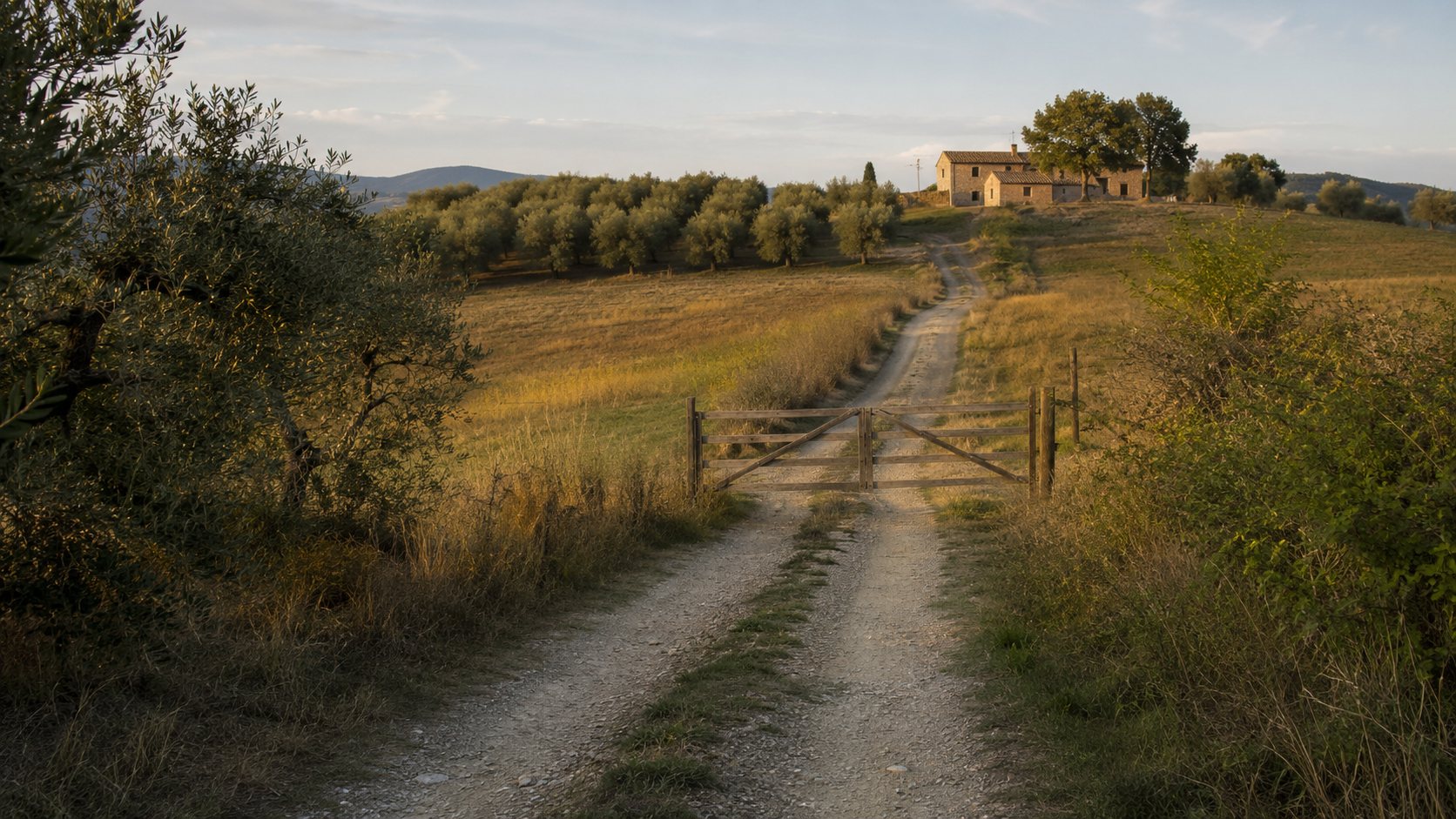
An illustrative, anonymised composite based on situations we commonly see. Details are for explanation, not a description of a specific client or property.
A buyer from the United States had fallen for a stone country house in the hills of Le Marche: a restored farmhouse with olive trees, long views, and the kind of quiet that sells itself in a single afternoon visit. The agent was warm, the photographs were honest, and the price felt fair. The one detail nobody dwelt on was the most important one. To reach the house at all, you drove up a gravel track that left the public road, ran for a few hundred metres across the neighbour's field, and only then arrived at the gate. It had been used that way "for years", everyone agreed. Nobody could show us, on paper, that the buyer would be allowed to keep using it.
THE CASE AT A GLANCE
- Property: a restored stone farmhouse in the hills of Le Marche, reached only by a private track.
- The red flag: the access track crossed a neighbour's land, used informally "for years" but with no registered right of way.
- What we did: traced the route on the cadastral map and flagged that legal access was not guaranteed to transfer, with the formal checks passed to local professionals.
- Outcome: the buyer paused, asked the right questions before signing, and pursued a registered right of way rather than relying on goodwill.
The property
On its own terms the house was sound. The parcels being sold (the particella numbers on the title) matched the garden, the outbuilding, and the land the buyer expected. There was no dispute about what was included inside the boundary. The question was not what you were buying, but whether you could actually get to it.
How you actually reach it
When we traced the access on the catasto map, the picture was clear. The track did not run over the property's own land for most of its length. It crossed a separate parcel belonging to a neighbouring owner. In everyday life this had never been a problem: the previous owners and the neighbour got on, the gate was never locked, and the arrangement simply worked.
But "always used" is not the same as a registered, transferable right. In Italian terms, a formally recorded servitù di passaggio is a right that attaches to the land itself, binds the servient parcel the track crosses, and passes to whoever owns the property next. An informal habit, however old and friendly, attaches to nothing. A new owner inherits the goodwill of the previous neighbour only for as long as that goodwill lasts.
What we flagged
We are not lawyers, surveyors or notaries, and the formal work here belongs to licensed local professionals. Our role was to read the situation early, in plain English, and tell the buyer exactly which questions to put on the table before any money moved. We set out the following:
- Trace the access route on the cadastral map, parcel by parcel, from the public road to the gate.
- Identify whose land the track actually crosses, and confirm it is not the property's own.
- Check whether any registered servitù di passaggio already exists, and if so, exactly what it permits (vehicles as well as people, maintenance, width).
- Confirm that any such right transfers to a new owner and genuinely binds the servient land, rather than resting on a personal understanding.
- Prepare the precise questions for the notaio, and, if the position stayed unclear, for the buyer's own avvocato, so that a geometra could verify the route on the ground if needed.
What it meant for the buyer
The risk was not theoretical. With no registered right, a future neighbour, a new owner of the field, an heir, or simply a relationship that soured, could in principle restrict or block the only way in. A house you cannot reliably reach is worth markedly less than one you can. It can complicate a mortgage, since a lender wants secure legal access, and it can make resale far harder when the next buyer's adviser asks the same question we did.
None of this meant the purchase was a mistake. It meant the access needed to be put on a proper legal footing, ideally a recorded servitù di passaggio agreed with the neighbour, and far better to resolve that before signing the proposta di acquisto than to discover it afterwards, when the buyer's leverage has gone.
The lesson
Access is one of the quietest risks in rural Italy, precisely because it usually works fine until the day it doesn't. The track is there, the gate opens, and everyone assumes a right exists because a road clearly does. The map and the title tell a calmer, more accurate story than the afternoon viewing ever can. A few hundred metres of gravel can be the difference between a home and an island.
The takeaway
If a property is reached by a private track, ask not whether it has been used, but whether the right to use it is registered, transferable, and binding on the land it crosses. Establish that on paper, in advance, with the right professionals, and a beautiful house in the hills stays exactly that. That is the whole point of a buyer-side check before you sign.