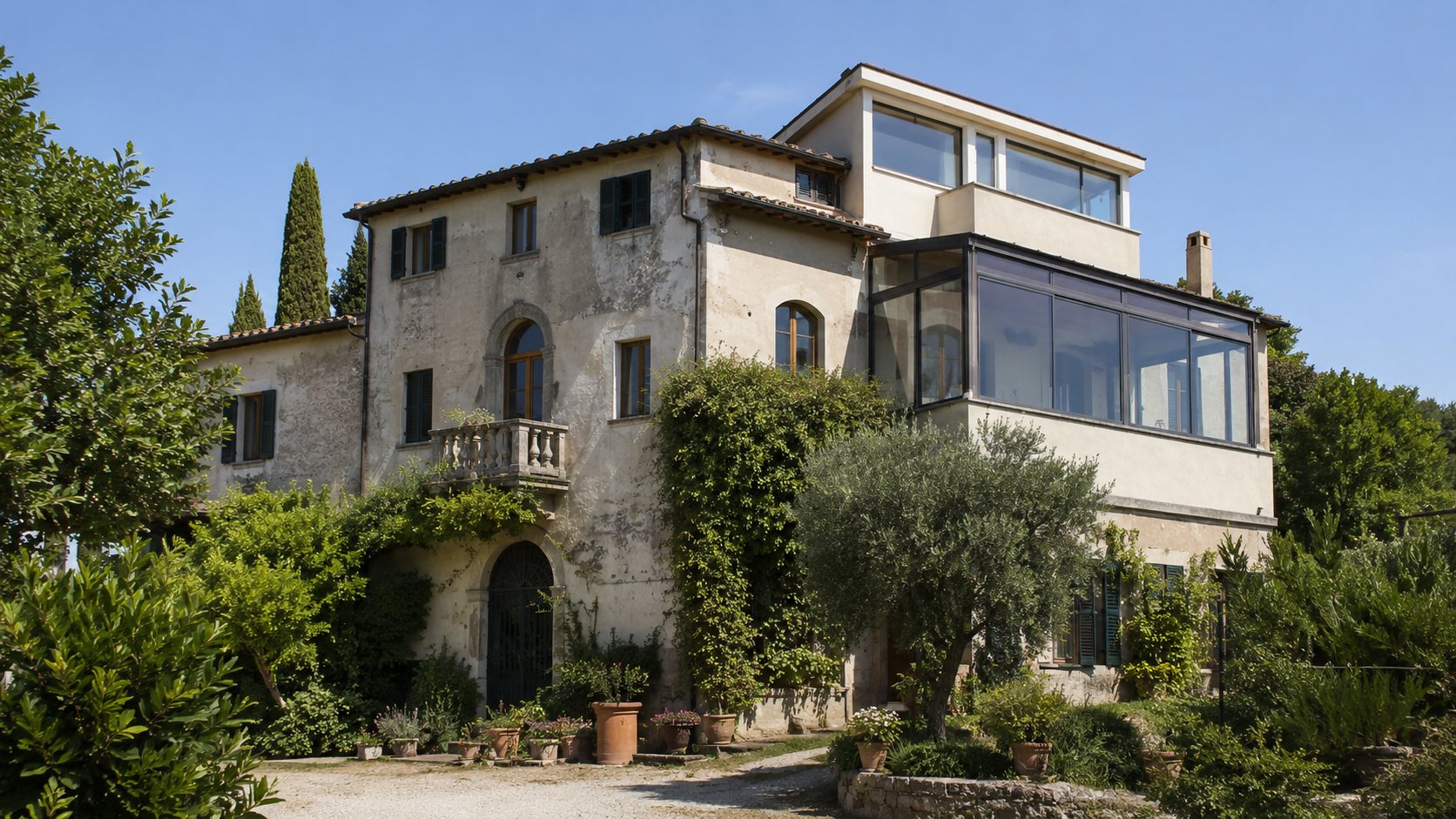
An illustrative, anonymised composite based on situations we commonly see. Details are for explanation, not a description of a specific client or property.
A couple from California had set their hearts on a tall, shuttered town villa a few streets back from the sea in a Ligurian harbour town. It had been beautifully presented: warm stone, a deep terrace, and, best of all, a top-floor room under the eaves with a long view over the rooftops to the water. They were ready to make a proposta di acquisto within the week. Before they signed anything, they asked us to read what was really being sold, and to do it quietly, before money and momentum made it awkward to ask questions.
THE CASE AT A GLANCE
- Property: a four-storey town villa near the harbour in coastal Liguria, with a converted top-floor room under the roof
- The red flag: the registered plans showed an open attic, not the finished, habitable room the buyers had been shown
- What we did: compared the catasto drawings line by line against the building, and set out which permits and authorisations needed to be requested before signing
- Outcome: the buyers paused, asked the right questions through their own professionals, and renegotiated on clear terms rather than discovering the problem later
The property
On paper the villa was straightforward: a single owner, no mortgage, and a tidy chain of past sales. The presentation leaned heavily on that top-floor room, described as a study with sea views and counted, informally, as living space. It was the room that made the asking price feel reasonable to the buyers. So it was the room we looked at first.
What the records showed
The catasto is Italy's record of how a property is registered for tax and identity purposes. It is not a guarantee of legality, but the plans it holds are a useful baseline, and they should broadly match what stands in front of you. Here they did not.
The registered drawings showed the top floor as an open, unconverted attic: no internal walls, no bathroom, no habitable layout. The building told a different story. The attic had been closed in, insulated, plumbed and turned into a finished room, the very space the sale was built around. Somewhere along the way, work had been carried out that was never reflected in the plans, and for which we could find no corresponding permission. In plain terms, this had the shape of abuso edilizio: building work done without the authorisations it required.
What we flagged
We are not lawyers, surveyors or notaries, and we do not pretend to be. Our role is to read the situation, name the risk, and say what must be verified and by whom. The formal work here belongs to licensed local professionals: a geometra to survey and reconcile the plans, and the buyers' own notaio to confirm what can and cannot be completed. We set out the checks they should commission:
- a line-by-line comparison of the catasto drawings against the building as it stands, room by room, so every difference is documented rather than assumed;
- a formal request at the comune for the building file: the permits and authorisations on record for the property, and specifically for the attic conversion;
- a check for any existing condono or sanatoria already applied for, and crucially whether it was ever completed, approved and paid in full, or merely started;
- an assessment, by a geometra, of whether the work can be regularised at all under current rules, or whether the room would have to be returned to its registered state.
What it meant for the buyer
The point that surprised our clients most is the one that matters most: planning irregularities follow the building, not the person who created them. Buy the villa as it stands and you inherit the problem, regardless of who did the work or when. That has a long reach. An unregularised conversion can complicate any future resale, since the next buyer's advisers will find exactly what we found. It can affect a mortgage, because lenders may decline to lend against space that is not properly registered. It can sit awkwardly with insurance. And a notaio, who must be satisfied the property is properly described, may be unwilling to complete at all until the records and the building agree. Separately, a room without proper agibilità, the certificate that it is fit for habitable use, is not the asset the price assumed.
The lesson
A beautiful room is not the same as a registered one, and the gap between the two can be expensive. Regularising work after the fact, where it is even possible, can run to a high-six-figure euro sum once fees, fines and building works are added, and sometimes the honest answer is that the space must simply come back out. None of this was visible in the photographs. It became visible the moment the plans were laid beside the building.
The takeaway
The buyers did not walk away. They paused, asked the right questions through their own advisers, and went back to the table knowing what they were really buying and what it would cost to put right. That is the difference a quiet read makes before the signatures rather than after. If you are buying in Italy and something seems too good to be true, or simply too good to leave unchecked, consider a buyer-side check before you sign.