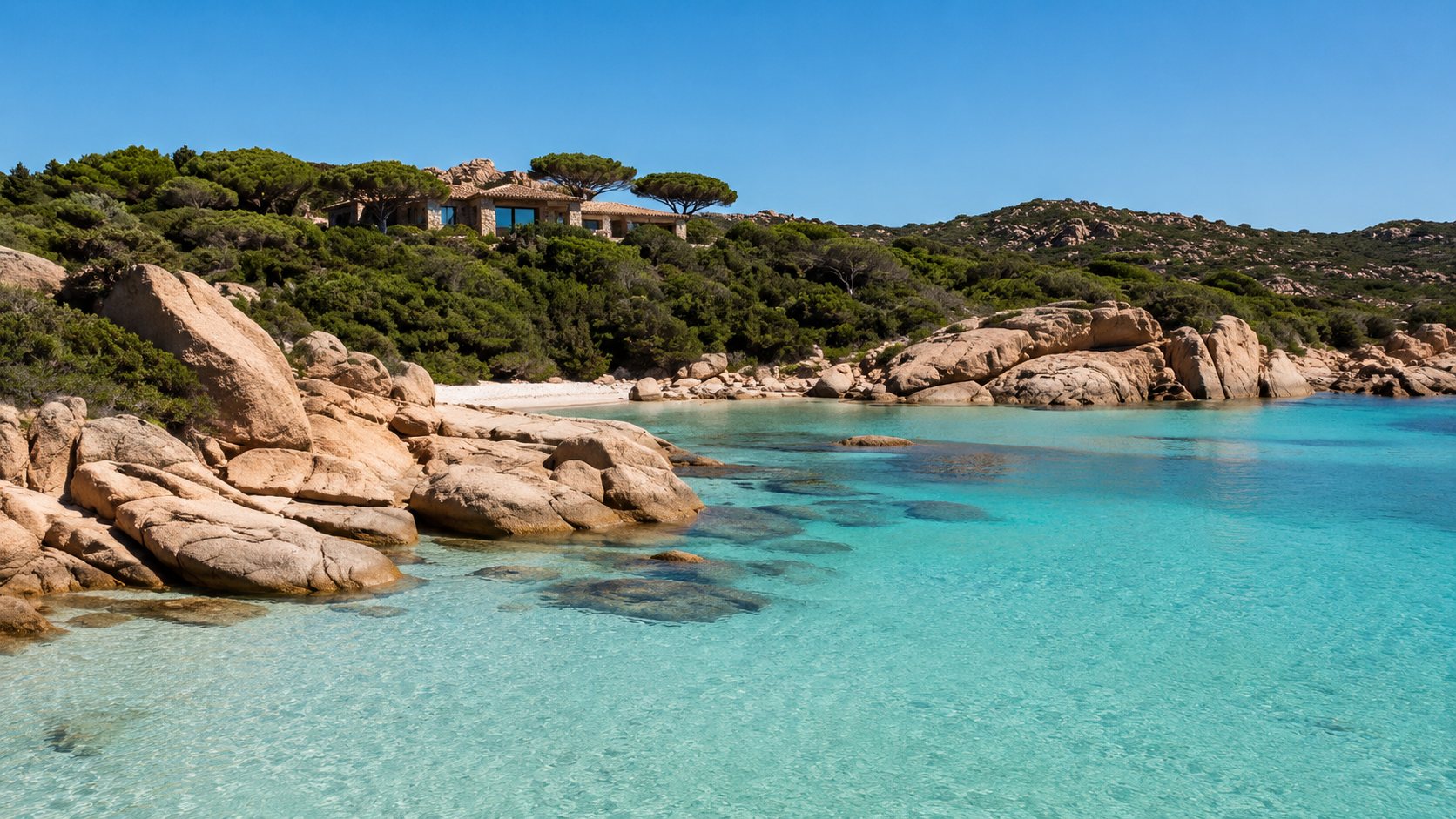
Sardinia sells a dream of turquoise water and granite-fringed coves, but the reality of buying property in Sardinia is a layered one. The island runs from the glossy euros of the Costa Smeralda to quiet inland villages where stone houses change hands for a fraction of the coastal asking prices. The water looks the same in the photographs; the rules, the costs and the constraints behind each plot do not. This guide sets out what separates a clean Sardinian purchase from an expensive misunderstanding.
WHAT TO CHECK FIRST
- Planning zone: where the plot sits under the regional landscape plan, and how close it is to the coastal strip.
- Buildability: whether a sea-view plot can actually be built on, extended or rebuilt at all.
- Permits: that what stands matches what was authorised, with no abuso edilizio on record.
- Records: that the catasto plans, the title and the agibilita certificate line up.
- Utilities: mains water, a legal drainage solution and a guaranteed access road, not assumptions.
- Access rights: any servitu (rights of way, shared wells, neighbour access) attached to the property.
One island, several very different markets
It helps to stop thinking of Sardinia as a single market. The north-east, around the Costa Smeralda and the wider Gallura, is the premium end: Porto Cervo, Porto Rotondo and the granite coast command the highest prices on the island, with international demand and a short, intense season. Prices fall, often sharply, as you move away.
The south, around Cagliari and the Chia and Villasimius coastlines, is a working capital region with its own beaches and a longer practical season. The west, from the Sinis peninsula down towards the south-west, is wilder and less developed, with fewer foreign buyers and lower prices. Then there is the interior: the Barbagia, the Marghine and the smaller villages where depopulation has left handsome stone houses for sale at modest figures. Each sub-market carries a different risk profile, and a price that looks like a bargain inland often reflects distance from services, an ageing local population and a thinner resale pool.
The landscape plan and the coastal strip
Sardinia is governed by a regional landscape plan, the piano paesaggistico regionale, which is unusually strict by Italian standards. Its central purpose is to protect the coast, and it does so by imposing strong limits on building within a defined strip back from the sea. Inside that strip, new construction is heavily restricted and in many areas effectively prohibited.
The practical consequence is blunt: a plot with a beautiful sea view is not automatically buildable, and an existing coastal house is not automatically extendable. Agents may describe land as "edificabile" or hint at expansion potential, but the landscape plan, the municipal plan and any specific vincolo (a binding constraint, whether landscape, archaeological or hydrogeological) sit above any optimistic sales pitch. Before you fall for the view, the only thing that matters is what the plan permits on that exact parcel. An independent verification of buildability, separate from anyone earning a commission on the sale, is the single most valuable step on a Sardinian coastal plot.
Unpermitted work and why the coast is unforgiving
Italy has a long history of building first and seeking permission later, and Sardinia is no exception. Abuso edilizio means construction or alteration carried out without the proper authorisation: an enclosed veranda, an extra bedroom, a pool, a guest annexe that never appears on the official record.
In some parts of Italy minor irregularities can be regularised after the fact. On the Sardinian coast this is materially harder, and in the protected strip it may be impossible: where the landscape plan forbade the work in the first place, there is often no path to legalise it later. That can leave a buyer owning a structure that cannot be sold cleanly, cannot be mortgaged and may in principle face a demolition order. Reconciling the catasto plans, the building permits and the physical structure is not paperwork to skip. It is the difference between a house you own and a problem you have bought.
Rural and coastal utilities: assume nothing
Away from the towns, services that buyers take for granted simply may not be present. Mains water is not guaranteed; many rural and coastal properties rely on a well or on delivered and stored water, and supply can be seasonal or pressured in the dry summer months. Legal drainage is a frequent weak point: a property may use a septic system that was never properly authorised, which interacts directly with the agibilita (habitability certificate) and with any future sale.
Access is the other quiet trap. A track to a rural house may cross a neighbour's land under a servitu that is informal, disputed or absent altogether, and "there has always been a road here" is not the same as a registered legal right of way. Electricity connection, distance to the grid and the cost of bringing services to a remote plot all belong on the checklist before, not after, contracts are signed.
Seasonality and what it does to value
Sardinia runs on a season. In much of the north-east, restaurants, shops and services open around late spring and wind down in September, and some coastal pockets are close to deserted in winter. That rhythm shapes everything: rental demand is concentrated into a few high-summer weeks, off-season letting is thin, and the buyers who will eventually take the property off your hands are themselves seasonal.
This matters for budgeting and for resale. A property that earns well for eight weeks still costs money for fifty-two, and a narrow buyer pool can make exit slower than the purchase suggested. None of this argues against buying; it argues for entering with clear eyes about how the season concentrates both demand and risk.
Getting there, and the distance trade-off
Sardinia has three main airports: Cagliari in the south, Olbia serving the north-east and the Costa Smeralda, and Alghero in the north-west. Ferries connect the island to the Italian mainland and beyond, useful if you intend to bring a car but slower and weather-dependent. Routes thin out markedly outside the summer timetable, which is part of the seasonality picture rather than separate from it.
The trade-off is straightforward. Coastal property near Olbia or Cagliari is easy to reach and easy to let, and you pay for that convenience. An inland village may be an hour or more from the nearest airport and from a hospital or a year-round supermarket, and the lower price reflects that distance. Be honest about how often you will actually make the journey, and in which months.
Frequently asked questions
Can I build a villa on a coastal plot with sea views?
Not on the strength of the view alone. The regional landscape plan restricts building within the coastal strip, and many sea-view plots cannot be developed or extended. Buildability must be confirmed against the plan and the municipal rules for that specific parcel before you commit.
Is unpermitted work a deal-breaker?
It depends on where and what. Some irregularities can be regularised; on the protected coast, others cannot be, which can make a property hard to sell or mortgage. The point is to identify the problem before purchase and price it in, rather than inheriting it unknowingly. See our note on the real cost of buying in Italy.
Are inland villages a good value alternative?
They can be, for the right buyer. Prices are far lower than the coast, but you are trading away services, year-round life and a deep resale market. An independent buyer-side check, drawing where needed on our trusted network of independent Italian professionals, helps you see what the low price is really reflecting.
Sources & further reading