Calabria, the toe of Italy, is among the cheapest regions in the country to buy a home, and that is exactly why buying property in Calabria rewards patience rather than haste. Low headline prices tend to attract buyers who skip the checks they would never skip at home. In a region with a long history of unpermitted building and fragmented family ownership, those checks are not a formality: they decide whether you end up with clear, sellable title or a problem you cannot easily undo.
WHAT TO CHECK FIRST
- Title: confirm every legal owner is identified and willing to sell, including all inheritance heirs.
- Planning: check the building matches its filed plans, and that any abuso edilizio is documented.
- Catasto: verify the catasto records match the physical property and the land registry.
- Habitability: ask whether a valid agibilità certificate exists.
- Access: confirm legal road access and any servitù di passaggio in writing.
- Utilities: establish that water, power and drainage are connected and lawful, not assumed.
Why "cheap" raises the stakes, not lowers them
Calabrian asking prices can be a fraction of those in Tuscany or the lakes, and genuine value exists across both the coast and the interior. But a low price often reflects a property that has sat unsold, sometimes for years, frequently because of an unresolved legal or planning issue. The cheaper the home, the smaller the budget feels for professional checks, and the greater the temptation to proceed on trust. That logic is backwards. A modest purchase price means a modest sum to protect, and an independent buyer-side check is proportionately even more worthwhile. Scalini does not sell property and takes no commission from any sale, so our only interest is what the paperwork actually says.
Unpermitted building is common, and not always fixable
Abuso edilizio, building work carried out without the correct permits, is widespread in Calabria's coastal and older rural stock. Extra rooms, enclosed terraces, additional floors and detached outbuildings were often added over decades with no filing at the comune. When the work is minor and historic, a sanatoria (a retrospective amnesty or regularisation) may be available. It is not guaranteed. Some abuso cannot be regularised at all, particularly in coastal, seismic or landscape-protected zones, and unregularised work can block a future sale, a mortgage, or even expose the owner to demolition orders. Crucially, if you buy a property with undocumented work, you inherit the problem. The check that matters is comparing the filed plans against what is physically there, before you commit.
Fragmented inheritance: who actually owns it
Italian succession law divides estates among many heirs, and in Calabria, where families are large and emigration scattered relatives across the world, a single old house can have a dozen or more co-owners. If the successione (the inheritance) was never properly registered, the people offering to sell may not yet hold legal title at all. Every living owner, or their representative, must sign the deed for the sale to be valid. One absent or unwilling heir can stall the transaction indefinitely. Confirm early, in writing, that the seller can deliver clear and complete title, and that the successione has been formally registered. This is one of the most frequent reasons a tempting Calabrian deal quietly falls apart, and it is far better discovered at the start than after a deposit.
The 7% flat tax in some southern towns
Italy offers a 7% flat tax on foreign income for new residents who draw a foreign pension and move their tax residence to a qualifying small town in the south, Calabria included. The town must generally have fewer than a set number of residents, and you must genuinely relocate your tax residence, not merely buy a holiday home. Eligibility depends on the specific comune and on your own circumstances, so it should be confirmed with a qualified tax adviser before you rely on it. We explain the mechanics in our guide to Italy's 7% flat tax for retirees. It is a real incentive, but it is a tax decision, not a property one, and it should never be the sole reason to buy a particular house.
Rural and coastal utilities, and legal access
Outside the towns, nothing about services should be assumed. A rural property may rely on a private well, a septic system, or a shared spring, and the legal right to use them is not always documented. Mains water, electricity and drainage connections that appear to exist may not be lawfully registered. Legal road access is the other recurring trap: many inland and hillside plots are reached over a neighbour's land, and that right must exist as a recorded servitù di passaggio, not merely a handshake. A track you drove along to view the house is not proof you are entitled to use it. These points are easy to verify and expensive to ignore.
Coast versus hill villages, Tyrrhenian versus Ionian
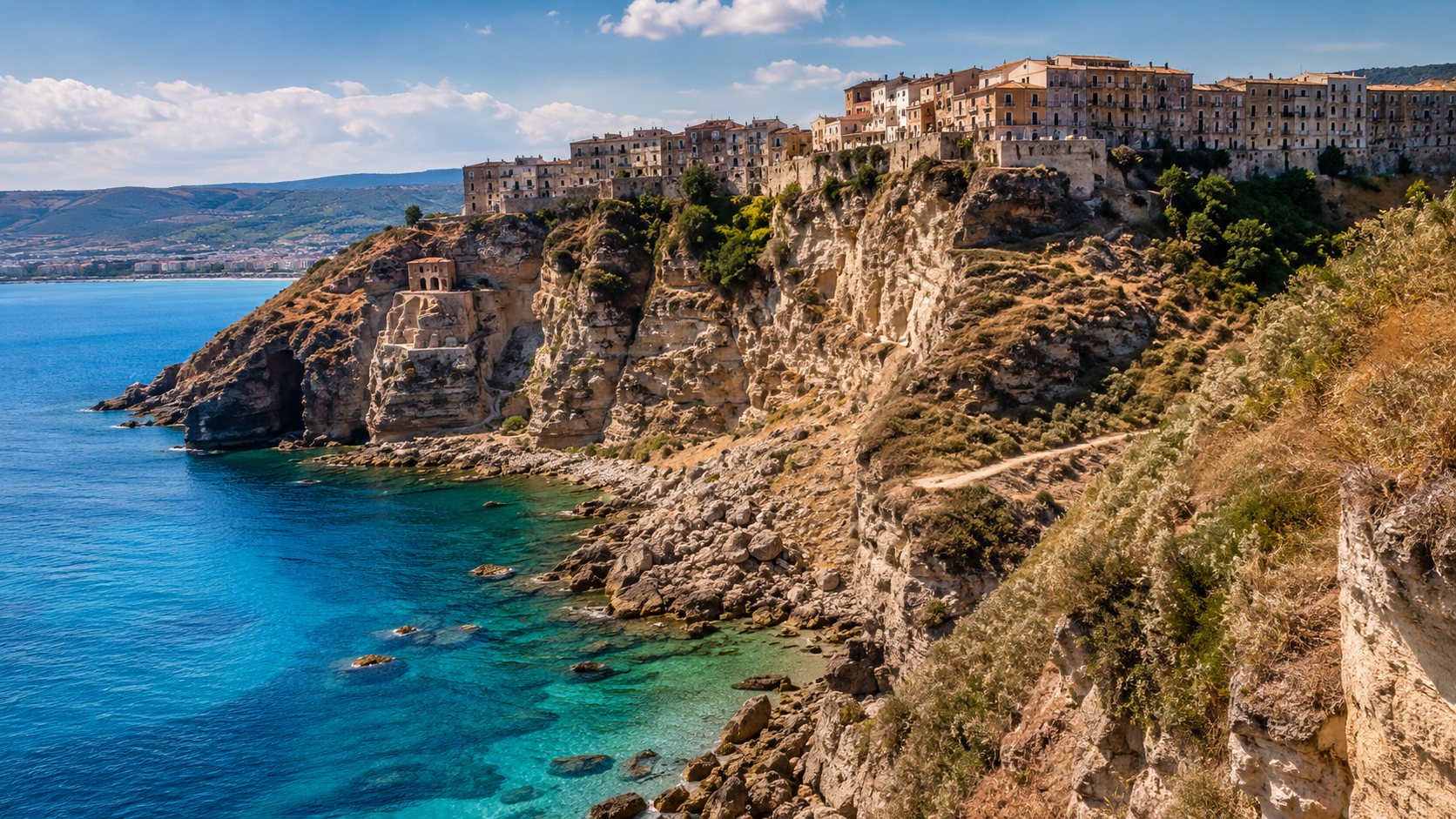
Calabria has two very different coastlines. The Tyrrhenian side to the west, around Tropea and the Coast of the Gods, is more developed and sees more tourism. The Ionian side to the east tends to be quieter and flatter, with long beaches and lower prices still. Inland, the hill villages of the Aspromonte, Sila and Pollino offer stone houses for very little, but also the steepest planning and access risks, more depopulation, and thinner services. There is no single right answer; the point is that the property type drives the checks. A village townhouse, a coastal apartment and a remote rural ruin each carry a different risk profile.
Getting there
Calabria is served by two main airports: Lamezia Terme in the centre, the busiest and best connected for international flights, and Reggio Calabria in the far south. Lamezia is the practical hub for most foreign buyers and for reaching either coast. Bear in mind that a property looks very different in February than in August, and that travel time to an airport matters as much for resale as for your own visits.
Frequently asked questions
Is it safe to buy a very cheap house in Calabria?
It can be, but a low price is a reason to check harder, not to relax. The most common issues, unpermitted work and unregistered inheritance, are exactly what make a property cheap and hard to sell on. An independent review tells you which of those apply before you commit.
Can unpermitted building always be regularised?
No. A sanatoria is sometimes available for minor historic work, but some abuso edilizio cannot be regularised, especially in coastal, seismic or protected areas. Whether yours can is a question for a qualified professional, checked against the comune's records before purchase.
Do I need a lawyer if I already have an agent?
The estate agent acts for the sale, and the notary checks the deed is valid, but neither is your independent adviser. Scalini connects you with a trusted network of independent Italian professionals who work for you, the buyer, alone.
Sources & further reading