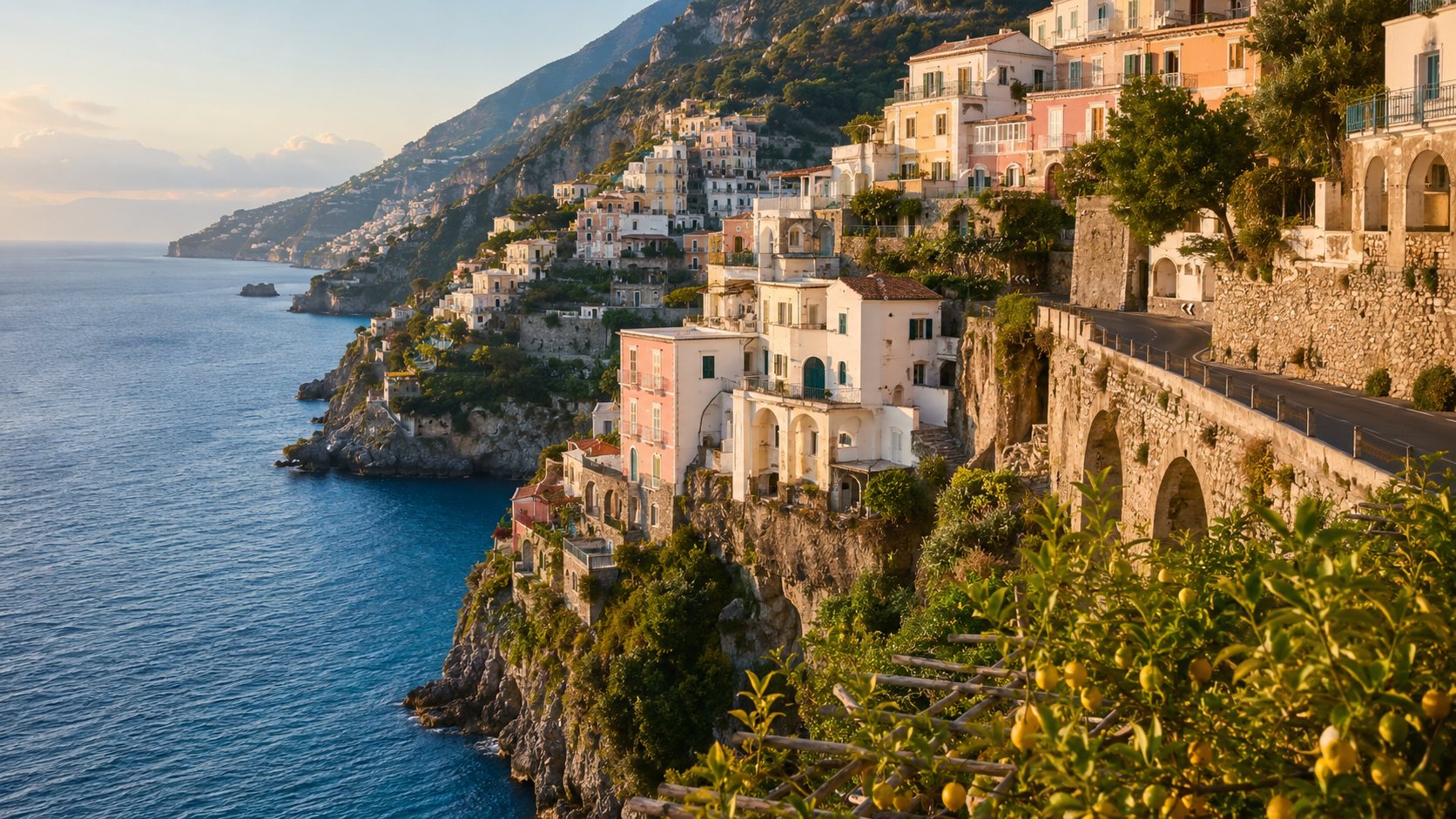
The Amalfi Coast is one of the most desirable places to own a home anywhere in the Mediterranean, and one of the most difficult to buy on with your eyes open. The villages of Positano, Amalfi and Ravello are spectacular, constrained and expensive in roughly equal measure, and many of the things that make them beautiful are the same things that make ownership complicated. If you are seriously considering buying property on the Amalfi Coast, it is worth understanding what you are actually buying into before you fall for a view. This guide is a calm reality check, not a sales pitch.
WHAT TO CHECK FIRST
- Protection: the whole coast sits under vincolo paesaggistico, so almost any change needs authorisation.
- Permits: check for abuso edilizio, unpermitted work that on a protected coast may not be regularisable.
- Records: confirm the catasto plans match the building as it actually stands today.
- Habitability: ask whether a valid agibilità certificate exists for the living space.
- Access: count the steps, and establish exactly where you can park and who owns the path.
- Rights of way: look for any servitù over the access, the terraces or the water supply.
Extreme scarcity, extreme premium
There is very little land on the Amalfi Coast, almost none of it flat, and effectively no possibility of creating more. The result is a market where the gap between an ordinary Italian property and an Amalfi property is enormous, and where the premium is paid for position, view and the simple fact of being there. Prices are set by scarcity rather than by floor area or condition, which means a small apartment with the right outlook can cost more than a far larger home a short drive inland. None of this is wrong, but it changes how you should think about value. You are not buying square metres; you are buying a position that almost cannot be replicated, and you should be confident the legal and physical reality matches the price.
The whole coast is protected, and that changes everything
The Amalfi Coast is a UNESCO World Heritage landscape and the entire area sits under vincolo paesaggistico, a binding landscape protection. In practice this means new building is largely impossible, and even modest changes to an existing property, a new window, a larger terrace, a pergola, a change of external materials, typically require landscape authorisation on top of ordinary planning consent. Approvals can be slow and are never automatic. If your plan depends on extending, reshaping or significantly modernising a house, treat that plan as uncertain until a local professional has confirmed what is realistically permitted on that specific parcel. The view you can never block is also a constraint you can never escape.
Unpermitted work is common, and not always fixable
Across Italy it is common to find that part of a building was altered, extended or enclosed without full permits, a situation known as abuso edilizio. On the Amalfi Coast this is especially frequent: terraces have been roofed, lower floors carved out of the rock, rooms added over decades of family ownership. Elsewhere some of this can be regularised after the fact by paying a fine and filing paperwork. On a protected coast, regularisation is not guaranteed, because work that breaches the landscape protection may not be eligible to be sanctioned at all. An unresolved discrepancy can block a sale, complicate a future resale and, in serious cases, expose an owner to orders to restore the original state. This is exactly where an independent buyer-side check earns its place, because the agent and the seller are not the people who will carry the consequences.
Access and parking: the part that decides daily life
Many Amalfi homes are reached only on foot, sometimes by long flights of steps cut into the hillside, with no vehicle access at all. A property described as central can still be a few hundred steps above or below the road. Parking is scarce, often shared or rented separately, and frequently a walk away from the front door. This matters far beyond the postcard. Consider how you will carry shopping, luggage and furniture; how an elderly visitor or a young family will cope; how you would manage a delivery, a repair or a medical call. Access also shapes resale, because the pool of future buyers narrows with every additional flight of steps. Be honest with yourself about the stairs you can climb in August heat, and the stairs you will still want to climb in twenty years.
Terraces, retaining walls and lemon groves
The coast is built on terraces held up by stone retaining structures, and these are part of what you own and must maintain. A collapsing terrace or a failing retaining wall is expensive, slow to repair under landscape rules, and occasionally a safety issue for the property below. Where a sale includes lemon-grove or agricultural land, check what that land actually permits and obliges: cultivation requirements, access tracks and shared boundaries are common. Look closely for any servitù, a registered right of way or right of use, that lets a neighbour cross your terrace, draw your water or pass along your path. If the property needs structural work, read our "Needs work" renovation warning signs before you commit, because on this coast a renovation is rarely as simple as it looks.
How it really lives off-season, and getting there
In summer the coast is glorious and crowded; out of season it is quieter, cooler and emptier than many buyers expect. Some restaurants, shops and ferry services close for months, the weather can be wet and windy, and the steep paths are less inviting in the dark. None of this is a reason not to buy, but it is a reason to visit in November as well as June. Getting there is its own commitment: Naples is the nearest airport, after which you face ferries in season or the famous coast road, a beautiful, narrow and often congested drive. Factor the real journey time, and the cost and effort of every arrival, into how often you will genuinely use the home.
Frequently asked questions
Can I extend or renovate a property on the Amalfi Coast?
Sometimes, but never assume it. Because the coast sits under vincolo paesaggistico, even small external changes usually need landscape authorisation, and larger works may simply not be permitted. Confirm what is realistic for the specific property, in writing, before you buy on the strength of a plan.
Is unpermitted work really a dealbreaker?
It depends on the work and whether it can be regularised, which on a protected coast is uncertain. The right approach is to identify any abuso edilizio early, understand whether it can be resolved and at whose cost, and never rely on a vague assurance that it will be "sorted out later".
Do I need professionals beyond the estate agent?
Yes. The agent represents the sale, not you. A purchase here typically involves a notary, a surveyor and often a lawyer, and you benefit from independent eyes on the planning, the records and the access. We can introduce you to a trusted network of independent Italian professionals who work for the buyer.
Sources & further reading