
DOCUMENTS
Catasto vs reality: when the floor plans don't match the house.
Cadastral mismatches are common in older Italian homes. Which ones are harmless, and which should stop you.
By the Scalini Group team | 23 Apr 2026 | 8 min read
DOCUMENTS
Cadastral mismatches are common in older Italian homes. Which ones are harmless, and which should stop you.
By the Scalini Group team | 23 Apr 2026 | 8 min read
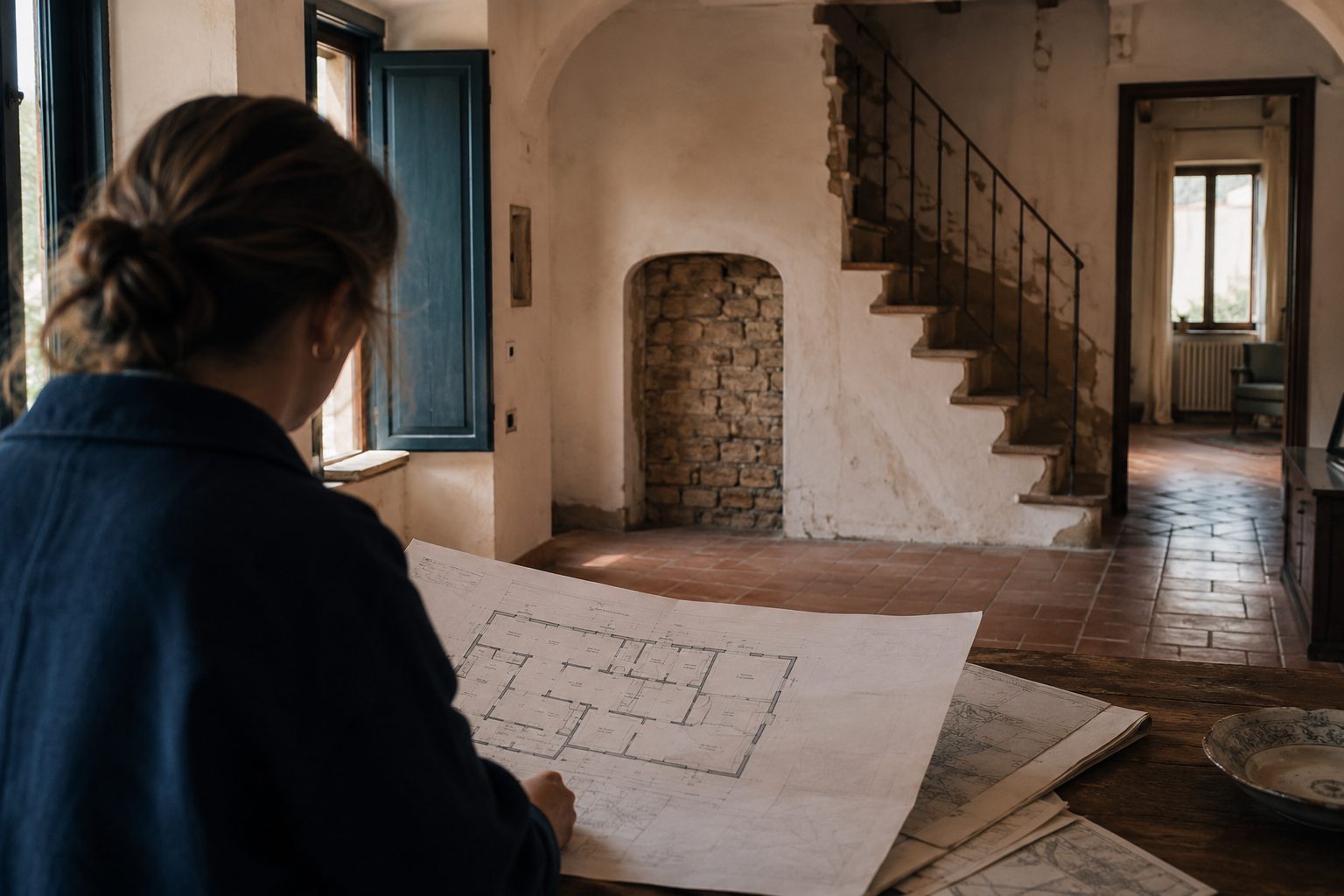
One of the most under-appreciated risks in buying an older Italian home is the gap between the property on paper and the property in front of you. Italy operates a strict requirement known as doppia conformità, double compliance, and since 2010 the notary is legally required to verify cadastral compliance before completing a sale. Get this wrong and the deed can be blocked, the bank can refuse to lend, and in the worst cases the act can be declared null and void. This is what every foreign buyer needs to understand about the catasto.
KEY FACTS AT A GLANCE
First, a crucial distinction many buyers miss: Italy keeps two separate record systems. The Catasto (cadastral records) holds the property's technical data and floor plan and serves mainly a fiscal purpose, calculating taxes like IMU. The Conservatoria (land registry) records ownership transfers, mortgages and liens. You need to check both to confirm clear title, because the cadastral record alone is not proof of legal ownership.
"Double compliance" means two different things must both be true:
A property can be compliant in the Catasto but not urbanistically, and vice versa. Both must be verified. And critically, the notary checks cadastral compliance but does not verify urban compliance, which is precisely where foreign buyers most often get caught.
Decades of small undocumented changes, an enclosed balcony, a divided room, an extra bathroom, an added outbuilding, leave many older homes out of step with their records. Some are minor and can be regularised through a simplified procedure or a building amnesty (paying a fine, the oblazione, and updating the plan). But not all irregularities can be legalised, particularly in protected coastal, landscape or archaeological zones, and the cost and time of regularisation can be significant.
A mismatch is not automatically a deal-breaker, but it is a question that must be answered, in writing, before you sign a binding proposal or pay a deposit. An unresolved discrepancy is one of the few issues that can genuinely void an Italian sale.
Not every irregularity is equal. A minor, recent change that complied with the rules in force when it was made can often be regularised through a sanatoria, updating the plan and paying a fine (the oblazione). But works that never could have been authorised, particularly in protected landscape, coastal, seismic or historic zones, may be impossible to legalise, and in serious cases can attract demolition orders. The distinction is technical, which is exactly why a geometra's certification, and a notary's title check, must happen before you are committed.
Double compliance: the property must match both its registered cadastral plan and the permits filed with the municipality.
Serious discrepancies can block completion or render the deed challengeable, which is why they must be resolved before signing.
A geometra updates the plan or pursues a sanatoria; agree in the contract whether the seller resolves it before completion.
Contact us and we'll tell you which level of check is most suitable. Independent, buyer-side, no commission from the sale.
Contact us ScaliniPRIVATE RELOCATION OFFICE