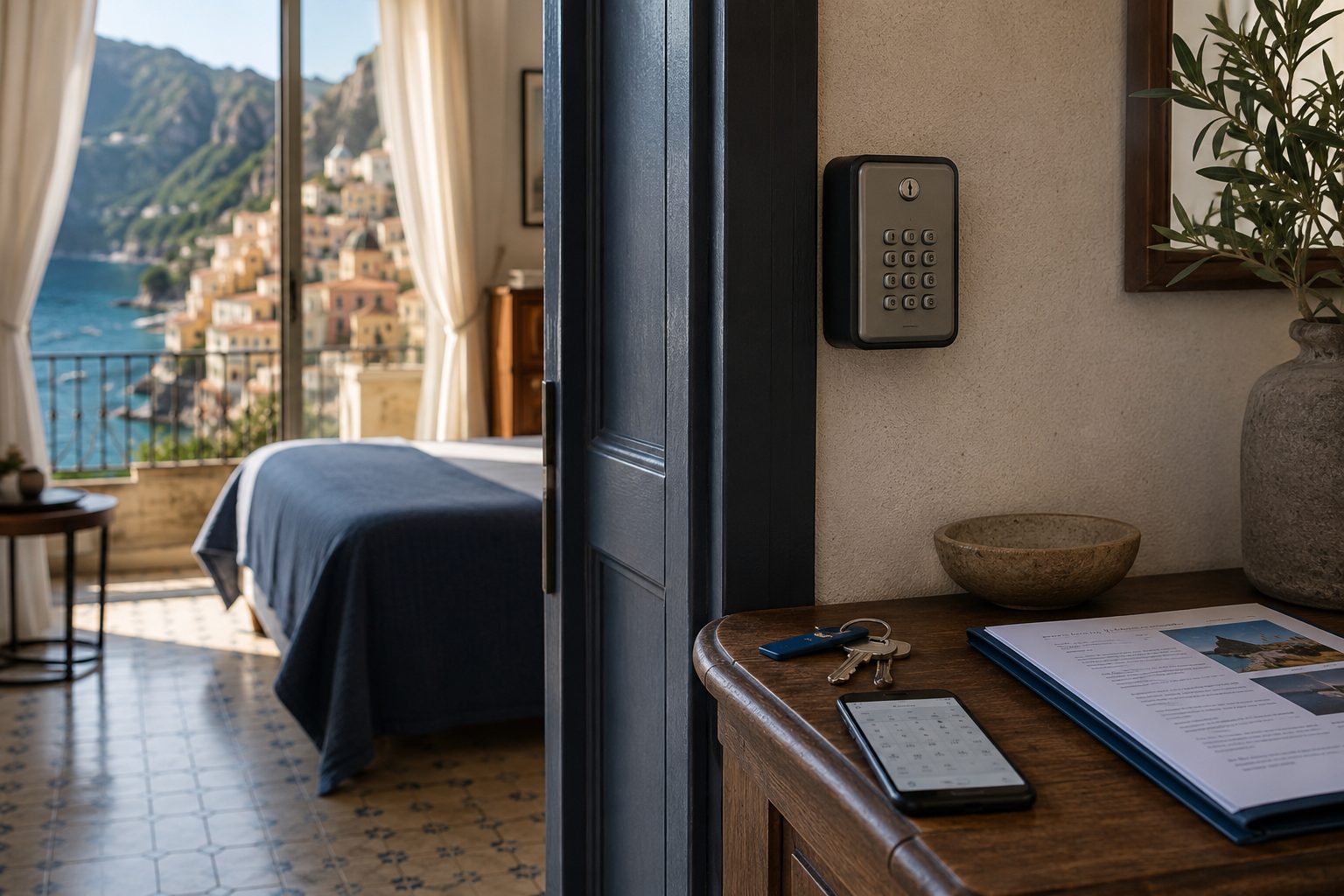
If your plan for an Italian property leans on short-term rental income, the ground has shifted dramatically beneath that assumption. Between late 2025 and 2026 Italy introduced a national registration regime, tightened taxes and handed cities new powers to limit tourist lets. Anyone modelling Airbnb-style returns on an Italian flat needs to understand the new rules before banking on the income. Here is what changed and what it means for foreign buyers.
KEY FACTS AT A GLANCE
- Registration: CIN code mandatory on every listing
- Flat tax: 21% first property, 26% on others
- From 3rd property: treated as a business (VAT)
- Check-in: key-boxes alone no longer allowed
- From 2027: platforms report income (DAC7)
- Local caps: bans now possible in dense areas
The CIN: national registration is now mandatory
Every short-term rental in Italy must now obtain and display a Codice Identificativo Nazionale (CIN), a national identification code, on the property and on every online listing. The measure is designed to bring an opaque market under control, and enforcement has bite: after the CIN rules took effect, a significant share of non-compliant listings disappeared, and platforms are being required to verify codes and remove listings without one. Operating without a CIN exposes hosts to fines that can run into thousands of euros.
Higher taxes on rental income
- The flat tax (cedolare secca) on short-let income sits at 21% on a first property and 26% on additional ones.
- From the third rented property, the activity can be presumed to be a business, triggering a VAT number and social-security contributions, a far heavier burden than before.
- From 2027, platforms such as Airbnb and Booking will report your income directly to the Agenzia delle Entrate under DAC7, which cross-checks it against your tax return.
The self-check-in and key-box clampdown
Following court rulings at the end of 2025, hosts can no longer rely on key boxes alone to check guests in. Identity must be verified in person or by video. The episode showed how quickly operating rules can change, and how the burden falls hardest on small, remote hosts rather than large managers with staff on the ground.
Cities are closing the door
Local authorities now have, and are using, powers to restrict short lets in dense tourist areas. Florence banned new tourist rentals in its UNESCO-protected historic centre in May 2025; Tuscany set a legal precedent allowing such limits, and other regions including Emilia-Romagna are preparing to follow. Milan raised its tourist tax for the 2026 Winter Olympics. The direction of travel is unmistakable: tighter, not looser.
What it means before you buy for rental income
The headline yield on a spreadsheet is now subject to registration, higher tax, possible business obligations and local caps that vary street by street. Before you buy a property on the strength of rental income:
- Confirm whether short lets are even permitted in that specific location, especially in historic centres.
- Check the property's current registration status (CIN) if it is sold as a going rental.
- Model the return after tax, compliance costs and realistic occupancy, not before.
Rental rules are now one of the most important, and most overlooked, parts of due diligence on an Italian investment purchase. Get an independent view before you commit.
How to model a short-let investment under the new rules
The realistic way to assess an Italian short-let in 2026 is to build the numbers from the bottom up, after compliance. Start with realistic occupancy, not peak-season optimism. Deduct the cedolare secca (21% on a first property, 26% on others), platform fees, cleaning and management, IMU and condominium costs, and the time or cost of compliant, in-person or video check-in. Then test the result against the possibility that the municipality restricts or bans new short lets, as Florence has. If the investment only works on gross, pre-tax, fully-booked assumptions, it does not work.
Long-let as the fallback strategy
Where short lets are restricted or marginal, a traditional long let offers steadier, if lower, income, taxed via the cedolare secca or progressive IRPEF, and free of the CIN and tourist-tax burden. Many investors now buy with a dual plan: short let where permitted and profitable, long let as a reliable fallback. A property that only stacks up as a short let, in a city tightening the rules, is a fragile investment.
Common mistakes with short-let rules
- Buying on assumed Airbnb income without checking local restrictions.
- Operating without a CIN and risking fines up to several thousand euros.
- Modelling returns before tax and compliance rather than after.
- Relying on key-box self-check-in, no longer permitted alone.
Frequently asked questions
What is the CIN code?
A national identification code every short-term rental must obtain and display on the property and on listings.
What tax applies to short-let income?
The cedolare secca flat tax of 21% on a first property and 26% on others, with business obligations from the third.
Sources & further reading