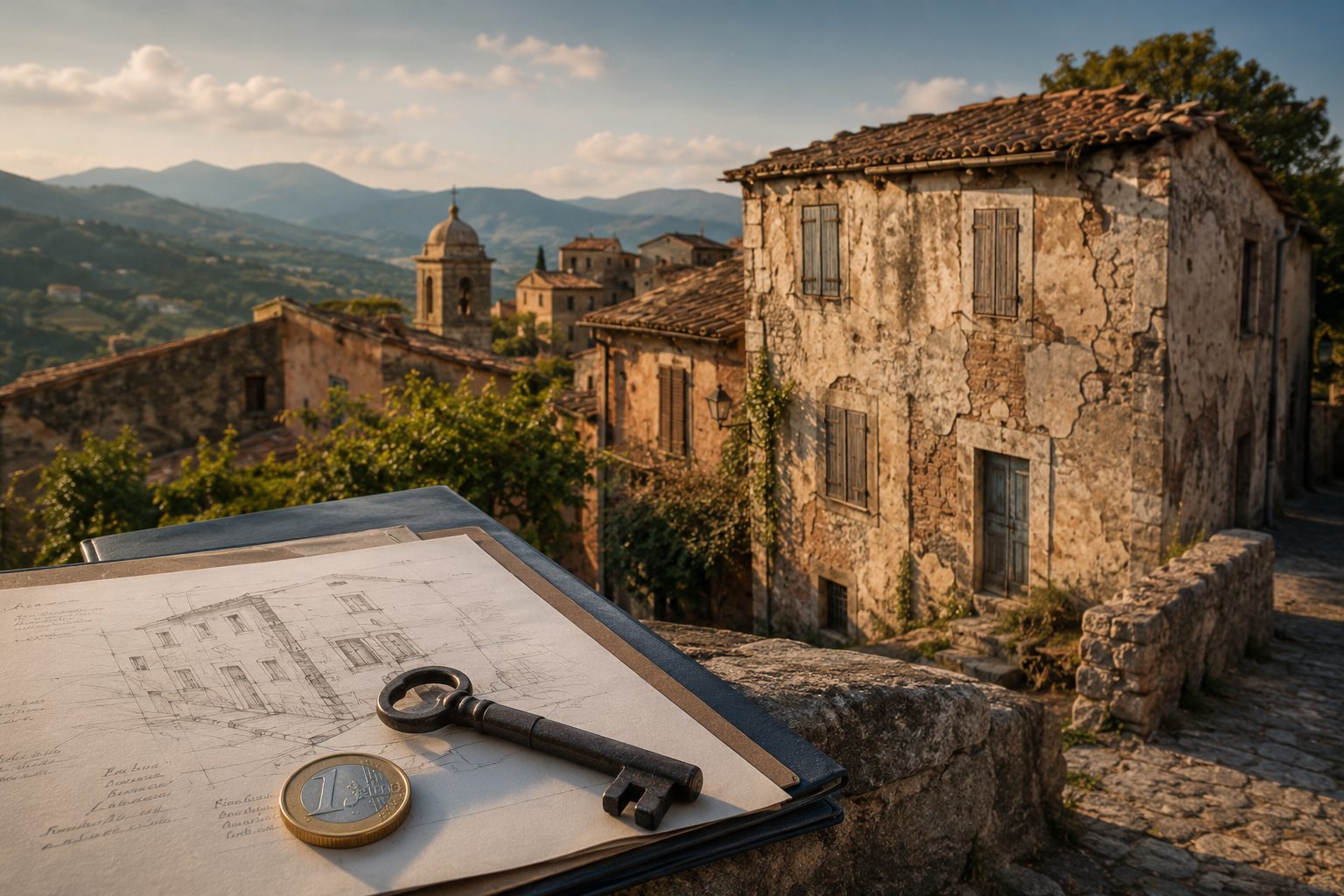
Few headlines have done more to fuel the dream of owning a home in Italy than the famous "one euro houses." Sicilian towns such as Sambuca di Sicilia, Mussomeli and Troina have sold crumbling stone properties for a single euro to anyone willing to take them on, and the story has run on CNN, the BBC and the New York Times. For an American or British buyer, the pitch is intoxicating: a foothold in Italy for less than the price of a cappuccino. But behind that one-euro price tag sits a far more complicated, and far more expensive, reality. This guide explains how the schemes actually work, what they really cost, and the questions every foreign buyer should answer before getting swept up in the romance.
KEY FACTS AT A GLANCE
- Headline price: €1 (nominal, genuine)
- Realistic all-in: €120,000–€160,000 for a 90 m² shell
- Renovation: typically €40,000–€100,000+; €1,000–€1,500 per m²
- Deadline: usually start within 1 year, finish within 3
- Deposit/guarantee: commonly €2,000–€5,000, forfeited if you abandon
- Residency: not included, a visa is separate
What is a one euro house in Italy, really?
A one euro house is a real, legally transferable property sold by an Italian municipality for a nominal price of €1. The towns running these schemes are almost always small inland borghi that have been losing population for decades as younger residents move to cities or abroad. Empty, decaying houses drag down the value and safety of an entire town centre, so selling them for a symbolic euro is a way for a comune to attract renovation money and new residents without spending public funds it does not have. In other words, the town is not being generous. It is making a trade: a worthless, often roofless building in exchange for your binding commitment to invest real money restoring it.
The conditions attached to one euro homes
Almost every scheme comes with obligations written into the sale contract. They vary from town to town, but the most common are:
- A renovation deadline. You typically must begin works within a set window, often one year, and complete them within three. Miss the deadline and you can face penalties.
- A security deposit or guarantee. Many municipalities require a bond, frequently between €2,000 and €5,000, which you forfeit if you abandon the project.
- A minimum renovation budget. Some schemes oblige you to spend a defined sum, sometimes €20,000 or more, on the restoration.
- Notary, survey and transfer costs. Even at a one euro price, the transaction is a legal property transfer that carries notary fees, taxes and registration, easily a few thousand euros in itself.
How much does it really cost to renovate a one euro house?
This is the number the headlines never put in the title. A one euro house is usually a shell: no functioning roof, no wiring, no plumbing and no guarantee the walls are sound. Realistic renovation budgets for these properties commonly run between €40,000 and €100,000 or more, depending on size, structural condition and how far the nearest qualified tradespeople have to travel. On top of the raw build cost sits the part foreign buyers underestimate most: managing a renovation in a foreign country, in a language you may not speak, frequently from thousands of miles away, in a town where reliable builders are scarce and heritage rules dictate what you may change. The era of Italy's most generous renovation subsidy, the 110% Superbonus, has largely ended, so you should not assume the state will absorb a meaningful share of the cost.
Does buying a one euro house give you residency in Italy?
No, and this is the single most common and most costly misunderstanding we see. Property ownership and immigration are entirely separate legal tracks. A one euro house does not come with a visa or a residence permit. As a non-EU citizen, you can only spend 90 days in any 180-day period inside the Schengen area without one. If your true goal is to live in Italy, the house is the easy part; the visa, most often the Elective Residency Visa for those with stable passive income, is the part that determines whether the dream is even feasible. Sort that question first.
And what about Italy's 7% flat tax?
Italy's 7% flat tax for foreign pensioners is real and genuinely attractive, but it is a separate programme with its own rules. Qualifying retirees who move their tax residence to an eligible southern town pay a flat 7% on foreign income for up to ten years, and in 2026 the eligible-town population threshold rose from 20,000 to 30,000, opening it to more places. It is not automatically tied to a one euro house, and it only helps if the town also works for your daily life: healthcare, transport and an airport you can actually reach.
So is a one euro house in Italy ever worth it?
Sometimes, yes. For a buyer who genuinely wants a project, has a realistic renovation budget, visits in person and treats the €1 as a starting line rather than a finish line, these schemes have produced beautiful homes and real community. The people who regret it are those who bought the headline instead of the building. Before you commit to any one euro listing, get clear on three numbers: the full renovation estimate from someone who has seen the property, the total transaction and guarantee costs, and the cost of your visa pathway if you intend to stay. If all three still make sense, you may have found something special. If you cannot answer them, that is your signal to pause, and to get an independent, buyer-side opinion before you sign anything.
How to buy a one euro house in Italy, step by step
- Find an active scheme. Towns open and close their programmes; confirm the comune is currently running one and has available properties, not just historic press coverage.
- Register your interest and view in person. Reputable schemes let you select from available houses. Never commit to a specific property you have not seen or had inspected.
- Get a geometra's survey and a builder's estimate on the exact house, structural condition, roof, walls, services, before you sign anything.
- Sign the deed of sale before a notary and pay the nominal price plus taxes, fees and the renovation guarantee.
- Submit your renovation project to the municipality and obtain the relevant permits (CILA, SCIA or Permesso di Costruire depending on scope).
- Start within the deadline (often one year) and complete within the agreed window (often three), or risk penalties and losing your guarantee.
How the famous schemes compare
Not all one euro towns are equal. Sambuca di Sicilia became so popular after CNN and New York Times coverage that homes now sell by competitive auction, often well above one euro. Mussomeli has built one of the most established international communities, with a support network that makes renovation noticeably easier. Troina has offered restoration incentives reported up to €15,000. Towns in Calabria and other southern regions run their own variants, some pairing the cheap house with separate relocation grants. The lesson: choose the town for its services, community and connectivity first, and treat the price as secondary.
Financing and the residency reality
Italian banks rarely mortgage one euro houses, the values are too low and the works too uncertain, so most buyers fund the purchase and renovation from savings or home-country finance. And because the schemes are often marketed to foreigners dreaming of a new life in Italy, it bears repeating: the house gives you no right to live here. A non-EU buyer is still limited to 90 days in any 180 without a visa, and the Elective Residency Visa requires substantial passive income. Sort the immigration question in parallel with the property, never after.
Worked example: the true cost of a "€1" house
Picture a typical Sicilian one euro house. The purchase price is €1, but the realistic all-in looks more like this: notary, transfer taxes and registration around €3,000; a municipal renovation guarantee of €3,000; and a full restoration of a 90 m² shell at €1,000–€1,500 per m², so €90,000–€135,000. Add a 15% contingency and project management, and the "one euro house" comfortably becomes a €120,000–€160,000 commitment before furniture. That is still potentially good value, but it is not a bargain you stumble into.
Common mistakes buyers make with one euro houses
- Treating the €1 as the cost rather than the entry ticket.
- Buying before getting a builder to walk the actual property.
- Assuming the house comes with the right to live in Italy.
- Underestimating the difficulty of managing a remote renovation in a town with few trades.
- Missing the renovation deadline and forfeiting the deposit.
Frequently asked questions
Can I really buy a house in Italy for one euro?
Yes, the nominal price is genuine, but it is tied to binding renovation obligations and a deposit you lose if you do not complete the work.
Do one euro houses come with residency?
No. Property ownership and the right to live in Italy are separate; you would still need a visa such as the Elective Residency Visa.
How much should I budget to renovate one?
Commonly €40,000 to €100,000-plus depending on size and condition, plus a contingency, since these properties are usually shells.
Glossary: key Italian terms
- Borgo: a small historic village, the typical setting for these schemes.
- Comune: the municipality running the programme and writing the rules.
- Geometra: a licensed surveyor who inspects condition and certifies compliance.
- CILA / SCIA / Permesso di Costruire: the building authorisations, from simplest to most involved, depending on the works.
- Caparra: a deposit; in these schemes, the renovation guarantee you can forfeit.
The verdict: who a one euro house actually suits
It suits a hands-on buyer with a realistic six-figure budget, time, patience and a willingness to visit and manage a project, ideally someone who wants the renovation as much as the result. It does not suit a buyer expecting a cheap turnkey holiday home, anyone relying on the €1 as the total cost, or someone assuming it solves the question of living in Italy. Treated with open eyes, a one euro house can be a genuinely rewarding way into Italian life. Treated as a bargain, it becomes an expensive lesson.
Related reading
Sources & further reading